Contact

Jojanneke van Summeren
Senior researcher Infectious Diseases in Primary Care

Duration: 2016 - 2024
The Global Epidemiology of RSV in Community and Hospitalized Care (GERi) study
 Rationale
 Respiratory syncytial virus (RSV) is the leading cause of acute lower respiratory infections in children. By the age of one, 60–70% of children have been infected by RSV (2%-3% of whom are hospitalized), and almost all children have been infected by two years of age. A global burden of disease study has recently shown that RSV is estimated to cause approximately 33.8 million new episodes of acute lower respiratory infections annually in children aged <5 years worldwide, resulting in 3.2 million hospital admissions and 59,600 in-hospital deaths in children aged <5 years in 2015. RSV is also recognized as a cause of illness in adults and high-risk adults, with a disease burden similar to that of seasonal influenza A.
 Impact RSV
To support optimal immunization strategies to prevent and control RSV in the future, it is critically important to understand who develops symptoms which lead to seeking healthcare and to identify which groups are at risk of more severe RSV infection requiring hospitalization or intensive care, as well as the impact on community care. There are currently approximately 60 RSV vaccine candidates and monoclonal antibodies that are in pre-clinical to phase III clinical trials, with potential target groups including elderly people, pregnant women and infants. An RSV vaccine is expected to enter the market in the coming years.
 Study aims and research questions
Knowledge about the spatio-temporal timing of RSV epidemics will be very important as this information will allow for the optimization of the delivery of vaccines (or monoclonal antibodies) in community and hospitalized care. RSV infection is not notifiable in all countries, but many countries have a long tradition of reporting laboratory-confirmed RSV infections through surveillance networks (often linked to influenza) that are already in place.
Whilst a fair amount is known about the epidemiology of RSV at country level, especially in the Northern Hemisphere, there is limited data on a global level and certain regions of the world (e.g. Central America, North Africa, Central Africa and the Middle East). In addition, very few studies have looked at the RSV burden (and spatio-temporal patterns) in the community versus hospitalized patients.
 Participating countries
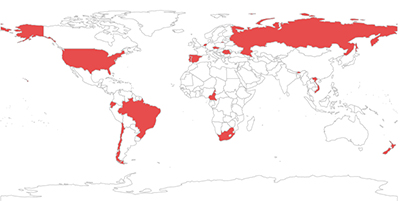
As of November 2020, 16 countries around the world have joined the project by providing their RSV surveillance data (see map).
 Methodology
The methodology of the Global Epidemiology of RSV in Community and Hospitalized Care (GERi) Study will be based on the Global Influenza B Study (GIBS) which was launched in 2012 (2012-2018) and collected information on the epidemiology and burden of disease of influenza B in the world since 2000 in order to support prevention policies. To achieve the GERi objective of including surveillance data from all world regions, we contact National Reference Centres in 40-50 countries around the world, with countries selected to represent all World Health Organization (WHO) regions. All countries will be asked to make data available from their national surveillance systems since 2000. Each participating country will be asked to provide the following data/information:
For countries that extend over large areas, especially when stretched across different climate zones (such as China and Brazil), we will ask for data stratified by region/province, if they are available. For countries with year-round RSV activity, we will collect data throughout the year.
There has been a lot of interest in the GERi database and we plan to open it to other Research Groups via the creation of the GERi Data Hub. Research Groups can submit a research proposal to GERi to get access to aggregated surveillance data in the GERi database. So far, Research Groups from the Max Planck Institute for Infection Biology and Nanjing Medical University have shown interest in accessing the data and a first manuscript is under preparation.
Preparing for RSV Immunisation and Surveillance in Europe (PROMISE)
As part of the PROMISE (https://imi-promise.eu/) project, Nivel will use the GERi surveillance data to model the impact of COVID-19 and the associated non-pharmaceutical interventions on RSV seasonality in Europe. This work will be carried out in 2022-2024.
RSV ComEU
We will initiate the RSV ComEU project within GERi in 2023. The aim of this project is to make RSV burden estimates in primary care in young children (aged 0-4 years) for the EU, EEA*, Switzerland.
The estimates will be based on a two Stage approach which takes single country estimates (based on a literature review) [=Stage 1] and extrapolates them to all countries in the European Union, EEA, Switzerland and United Kingdom (UK) [=Stage 2]. This approach has been applied to influenza-associated mortality rates for the 2009 pandemic (GLaMOR I) and seasonal influenza (GLaMOR II), and is currently being applied to RSV-associated hospitalizations (2008-2018).
*EEA=European Economic Area= Iceland, Liechtenstein and Norway
 Results: publications and presentations
We present all the results of the project: the posters and presentations you'll find below and the publications on the right.
 Project team
Susanne Heemskerk, MSc
Junior Researcher
Susanne Heemskerk graduated from the Vrije Universiteit Amsterdam with an MSc in Biomedical Sciences specialized in Infectious Diseases and International Public Health.
Jojanneke van Summeren, PhD
Senior researcher
Jojanneke is an experienced epidemiological researcher specialized in understanding and measuring the burden of respiratory infectious diseases and surveillance of infectious diseases. She has a lot of experience in conducting research in primary care settings.
Saverio Caini, MD, PhD, EPIET
Researcher
Saverio Caini is a medical doctor specialized in Hygiene and Preventive Medicine (2006) and has worked as a medical epidemiologist, both in the field of communicable and non-communicable diseases. He joined the European Programme for Intervention Epidemiology Training (EPIET) led by ECDC in 2010 and graduated in 2012.
 Funding
The GERi Study is funded by Sanofi and AstraZeneca.
 Want to know more?
For more information on this project, please feel free to get in touch with the Nivel expert(s) involved. You will find them on the right, together with the (future) Nivel deliverables (publications and other relevant content).
Contact: Jojanneke van Summeren, Senior researcher Infectious Diseases in Primary Care
Visiting address: Otterstraat 118-124, 3513 CR Utrecht, The Netherlands.
Postal address: PO Box 1568, 3500 BN Utrecht, The Netherlands.
Updated: 20 January 2025
Senior researcher Infectious Diseases in Primary Care